
EDITORIAL & NEWS

A Murder of Crows, an Infestation of Gipsies

by Nancy Holder & Margie Deck

On page 14, our narrator Dr. Harcastle informs us that he has had an encounter so shocking that he has been forced to his bed for six weeks. Obviously, we readers hope that he is about to Reveal All, but we will have to wait for the final face-to-face for four more pages. Sir Arthur Conan Doyle has now laid his cards on the table, promising that there is going to be a ripping good payoff for this “real creeper.” With the pacing of a master storyteller, Doyle establishes this page as the beginning of the good part, and he does this by ratcheting up the tension. Thus the stage is set for act three of “The Terror”—the climax.

After Hardcastle’s dramatic revelation that he has been undone by what he has witnessed, he provides the backstory. At the beginning of those harrowing six weeks, Armitage, “a very fine fellow for someone of his station,” as well as some sheep, went missing. Local fingers pointed at “gipsies and sheep-stealers.” This reference of “gipsies” as suspects caught our eye: Doyle mentions them twenty-three times in his fictional works, in a negative or at best neutral light. They usually lurk in the background, enhancing an established atmosphere of uncertainty and danger, although as University of Edinburgh scholar Alan Goodson points out in “The ‘Gypsies’ as Displaced Others in Doyle’s Sherlock Holmes Stories”, they are foregrounded as prime suspects in two of Sherlock Holmes’s cases (The Hound of the Baskervilles and “The Priory School”). In both instances, they are found innocent, and this is the foundation of Goodson’s thesis that Conan Doyle was a more tolerant English gentleman than others of his times. That may well be, but that is not the case in this non-Sherlockian work. It is clear that Doyle injected the lurking presence of Roma (the current more acceptable term) as a recognizable trope to increase his audience’s anxiety.

Doyle was not the only author to exploit Roma as shadowy markers of disturbance, for, as Goodson informs us, Roma had been reviled since before the reign of Henry VIII, and hunted down and murdered in European “Gypsy Hunts” as late as the nineteenth century. In Bram Stoker’s Dracula, they are agents of the vampire. In Wuthering Heights, “violent, dark” Heathcliff is described as a Gypsy with no known last name nor date of birth to put on his headstone.

A footnote on pages 234 and 235 of Doylean scholar Leslie S. Klinger’s annotation of “The Adventure of the Speckled Band” in The New Annotated Sherlock Holmes, Volume 1 reveals the origin of the Roma. They were called “gipsies” or “Gypsies” because it was believed that they had come from Egypt. They didn’t; they began migrating to Europe from northern India in the fourteenth century. Eventually becoming one distinct ethnic group, they have never assimilated. Thus they were (and still are) seen as Other by succeeding European generations.

In nineteenth-century England, they were persecuted under the Vagrancy Act, which Doyle discusses in The Land of Mist, a novel published in The Strand Magazine in 1925–1926. A lawyer, speaking to the judge at a trial, says of his client:

He is now prosecuted under the fourth section of the Vagrancy Act of 1824, which is styled, ‘An Act for punishing idle and disorderly persons, and rogues and vagabonds.’ The Act was intended, as the words imply, to restrain lawless gipsies and others, who at that time infested the country.

They are often still regarded as a lawless blight on civilized society, and Doyle has used this to his advantage on page 14. They hover, their story (and fate) left dangling off the page. But Doyle is not finished with employing other authorial tricks to keep us eagerly and fearfully waiting for our own meeting with The Terror of Blue John Gap…as we shall soon see.

Copyright 2026 Margie Deck & Nancy Holder


COMMENTARY & CREATIVITY

1910: Living in the Present, Writing
in the Past

by Margie Deck & Nancy Holder

As Doylean scholar Mattias Boström described within these pages, Arthur Conan Doyle’s summer months of 1910—when “The Terror of Blue John Gap” was written—were filled with travel, writing, publishing, sports, speaking engagements, politics, family obligations, and theatre productions. He was in and out of London on a regular basis then, and for much of the year as a whole.

continued . . .


The Question of the Inconceivable Fate

by Scott Monty

This is a curious observation, particularly the idea of it being "an inconceivable fate for a civilized English gentleman of the twentieth century." What could it mean?

continued . . .

NAVIGATE THE STORY, PAGE BY PAGE

front cover & matter: a (home) • bcd    back cover: e

text: 12345678910111213
14 • 15 • 16 • 17 • 18 • 19 • 20


YOU ARE HERE: 14
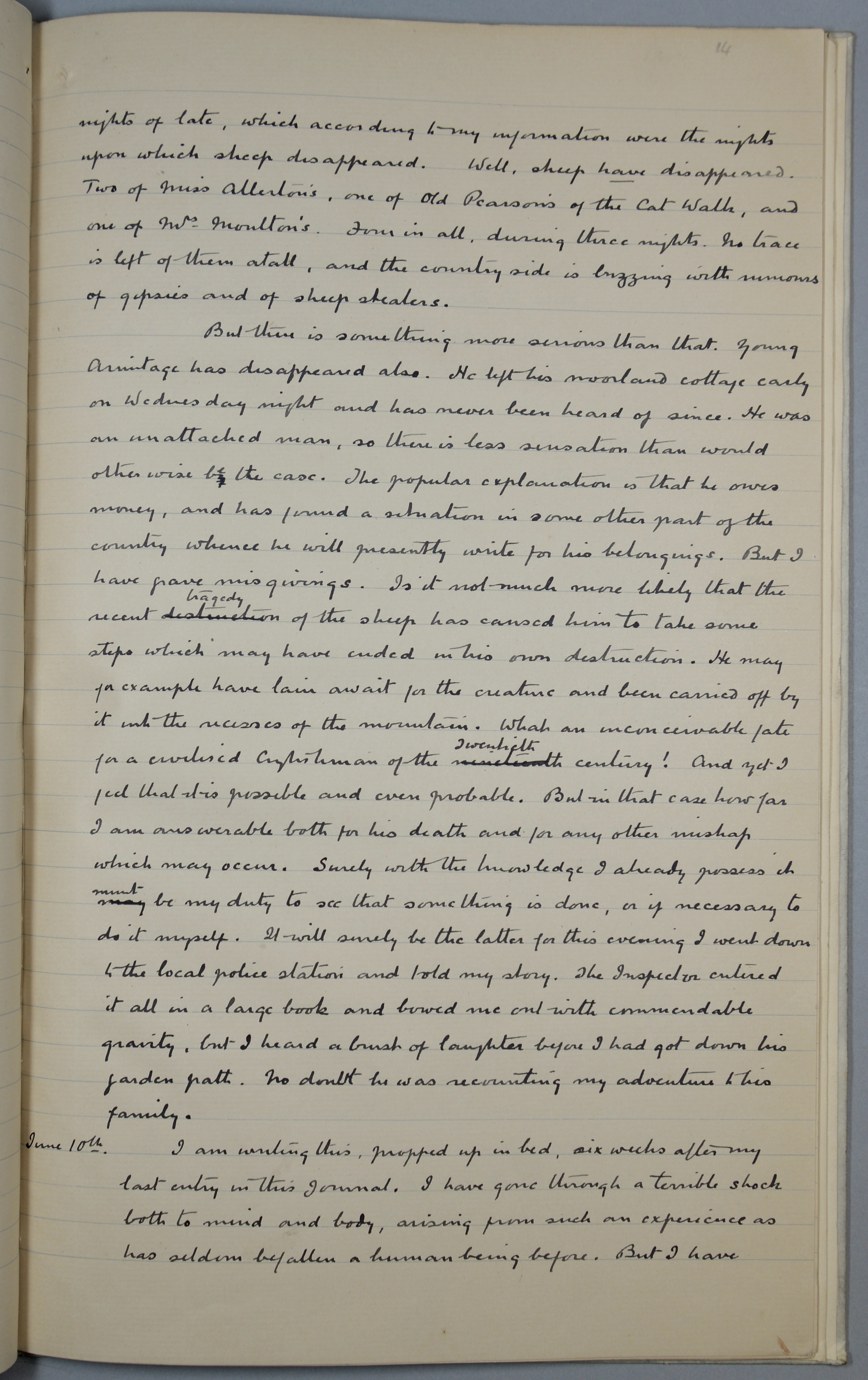
page 14 of the manuscript of The Terror of Blue John Gap

The autograph manuscript of “The Terror of Blue John Gap” reproduced above is courtesy of Dartmouth College Library, Rauner Special Collections, MS-93: Sir Arthur Conan Doyle.


Transcription

nights of late, which according to my information were the nights

upon which sheep disappeared. Well, sheep have ["have" is underlined] disappeared.

Two of Miss Allerton's, one of Old Pearson's of the Cat Walk, and

one of Mrs. Moulton's. Four in all, during three nights. No trace

is left of them at all, and the countryside is buzzing with rumours

of gipsies and of sheep stealers.

But there is something more serious than that. Young

Armitage has disappeared also. He left his moorland cottage early

on Wednesday night and has never been heard of since. He was

an unattached man, so there is less sensation than would

otherwise b[deleted: y / inserted: e] the case. The popular explanation is that he owes

money, and has found a situation in some other part of the

country whence he will presently write for his belongings. But I

have grave misgivings. Is it not much more likely that the

recent [deleted: destruction / inserted: tragedy] of the sheep has caused him to take some

steps which may have ended in his own destruction. He may

for example have lain await for the creature and been carried off by

it into the recesses of the mountain. What an inconceivable fate

for a civilised Englishman of the [deleted: nineteenth / inserted: twentieth] century! And yet I

feel that it is possible and even probable. But in that case how far

I am answerable both for his death and for any other mishap

which may occur. Surely with the knowledge I already possess it

[deleted: may / inserted: must] be my duty to see that something is done, or if necessary to

do it myself. It will surely be the latter for this evening I went down

to the local police station and told my story. The Inspector entered

it all in a large book and bowed me out with commendable

gravity, but I heard a burst of laughter before I had got down his

garden path. No doubt he was recounting my my adventure to his

family.

June 10th. I am writing this, propped up in bed, six weeks after my

last entry in this journal. I have gone through a terrible shock

both to mind and body, arising from such an experience as

has seldom befallen a human being before. But I have


The full story as it was printed in The Strand is available at
The Arthur Conan Doyle Encyclopedia.