
EDITORIAL & NEWS

Ghosts Doyle Sat Up For

by Margie Deck & Nancy Holder

As Lisa Morton rightly notes in her commentary, our Dr. Hardcastle does not report seeing ghosts while in Coltbridge; instead, Arthur Conan Doyle showcases Hardcastle’s bravery and nerve through merely his sitting up in a haunted house. In his own life Doyle did devote time to ghost-hunting and reported some of the results in detail.

He published “Ghosts I Have Seen” in the Weekly Dispatch of May 1, 1927, and then published an almost identical version titled “Ghosts That I Have Seen” in the Daily Mail of June 11, 1927. Oddly, considering this late date in his extensive Spiritualism promotion, he relates experiences of seeing ghosts but then somewhat discounts those experiences in his opening paragraph: “I have several times gone ghost-hunting, and have had some experiences in that direction, but they were not objective enough to make a dramatic narrative, and would fall rather under the heading of psychic and spiritualistic phenomena.”

Nevertheless, he goes on to tell of several instances wherein he encountered ghosts, including an adventure he had with his wife and children in tow in a supposedly haunted church:

There was a church in my neighbourhood which had the reputation of being haunted. There are reasons why it would be wrong for me to indicate it more precisely. One night seven of us set forth to explore the mystery. The party consisted of my wife and myself, my two sons, my daughter, a friend, and a young London lady who is among our rising poets. It was ten o’clock when we presented ourselves at the door of the church, where we were met by an elderly villager, who admitted us and then locked the door behind us.

Swinging a lantern, he led the way to the choir end, where we all seated ourselves in the stalls which the ancient monks once occupied. My own very angular throne was that which had been used by many in far-off days when the old church was one of the shrines of England.

Opposite me, and dimly lit by the lantern, was the altar, and behind it a black wall, unbroken by any window, but reflecting strange ghostly shadows and illuminations through the high clerestory windows on either side.

When the lantern was extinguished and we sat in the darkness watching these strange shifting lights coming and going the impression was quite ghostly enough, though I am not prepared to say that there may not have been a physical cause. The gleam from distant headlights cast at some strange angle was one explanation which crossed my sceptical mind.

For two hours I had sat in the dark upon my hard seat and wondered whether cushions were vouchsafed to the monks of old. The lights still came and went behind the altar, but they only flickered over the top of the high expanse which faced us and all below was very black.

And then, quite suddenly, there came that which no scepticism could explain away. It may have been 40 ft. from where I sat to the altar, and mid-way between, or roughly 20 ft. from me, there was a dull haze of light, a sort of phosphorescent cloud, 1 ft. or so across and about a man’s height from the ground.

We had been rustling and whispering, weary with the long waiting, but the sudden utter silence showed me that my companions were as tense as I was. The light glimmered down and hardened into a definite shape — or I should say shapes, since there were two of them. They were two perfectly clear-cut figures in black and white, with a dim luminosity of their own. The colouring and arrangement gave me a general idea of cassocks and surplices.

Whether they were facing the altar or facing each other was more than I could say, but they were not misty figures but solid objective shapes. For two or three minutes we all gazed spellbound at this amazing spectacle. Then my wife said loudly: “Friends, is there anything which we can do to help you?” In an instant they were gone, and we were peering into an unbroken lower darkness with the lights still flickering above.

Personally, I saw no more, but those of our party who sat upon the right said that they could afterwards see a similar figure but somewhat taller — a man alone — who stood on the left of the altar. For my own part nothing more occurred, and when midnight clanged forth above our heads, I thought it was time to make for the waiting motor.

Such was our experience. There was no possible room for error. Unquestionably we all saw these figures, and equally unquestionably the figures were not of this world.

While we cannot attest there was no possible room for error, we believe the story is quite a dramatic narrative indeed—the type of narrative we would expect from the creator of Sherlock Holmes and “The Terror of Blue John Gap.”

Copyright 2026 Margie Deck & Nancy Holder


COMMENTARY & CREATIVITY

Sitting with Spiritualism in Doyle’s Time

by Lisa Morton

On this page of the manuscript, Dr. Hardcastle tells us: “When I was a student I had the reputation of being a man of courage and enterprise. I remember that when there was a ghost hunt at Coltbridge it was I who sat up in the haunted house.”

continued . . .


No Longer an Invention: Doyle’s Creation of Realistic Characters

by Naching T. Kassa

The Victorian Era was a wonderful age of discovery and a time of great awareness. Men like Henry Morton Stanley, Dr. David Livingstone, and Sir Richard Burton explored the outer world, while Sigmund Freud, Alfred Adler and Carl Jung explored the inner. Perceptions were ever-changing, often treading the narrow path between logic and the fantastic. Arthur Conan Doyle, like most horror and mystery writers, understood this all too well. He knew “The Terror of Blue John Gap” would fail to frighten his readers if James Hardcastle were not a believable, living, breathing character. Doyle had to bring Hardcastle to life, and he did it in a very clever way.

continued . . .

NAVIGATE THE STORY, PAGE BY PAGE

front cover & matter: a (home) • bcd    back cover: e

text: 123456789101112 • 13
14 • 15 • 16 • 17 • 18 • 19 • 20


YOU ARE HERE: 13
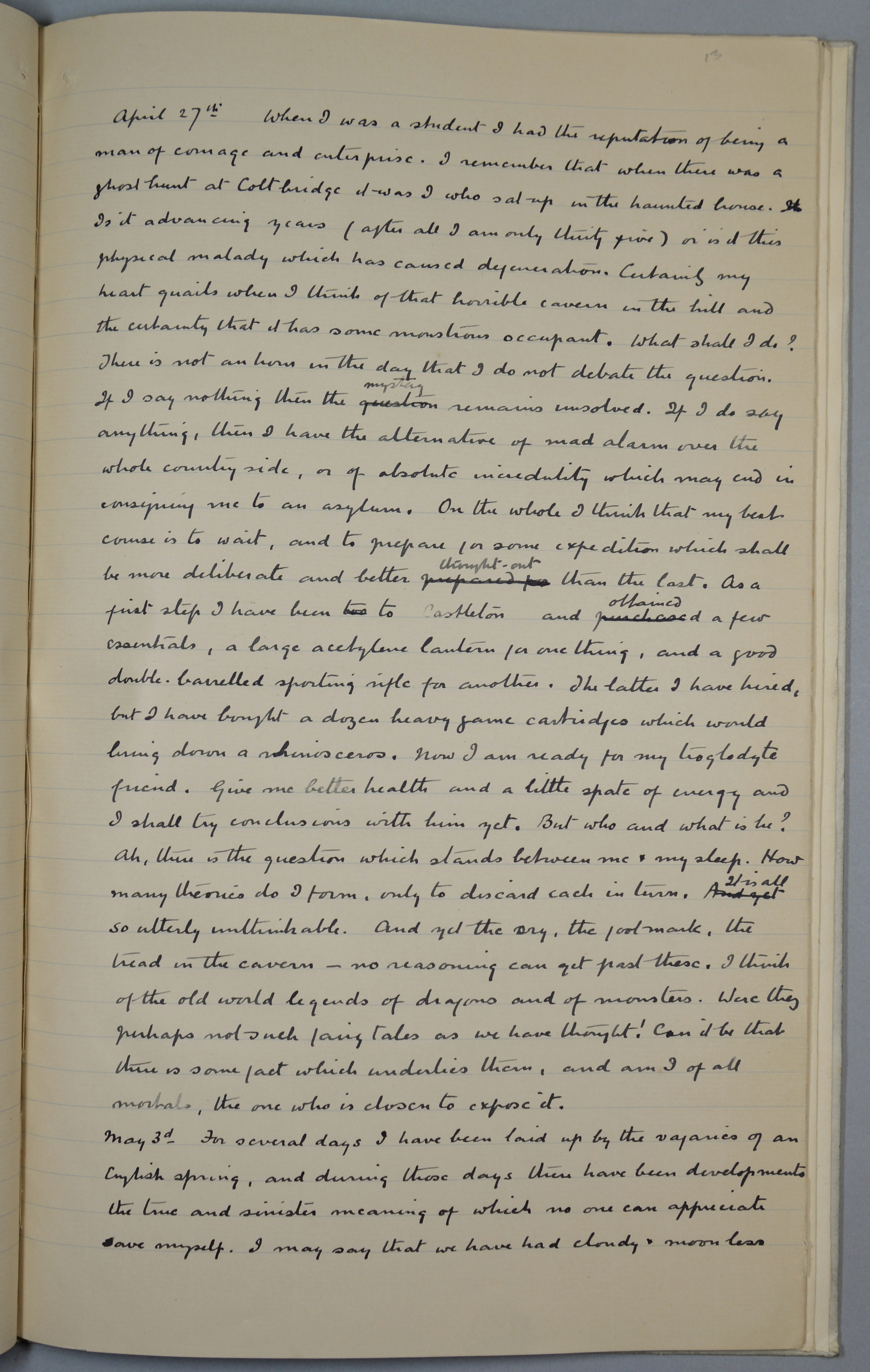
page 13 of the manuscript of The Terror of Blue John Gap

The autograph manuscript of “The Terror of Blue John Gap” reproduced above is courtesy of Dartmouth College Library, Rauner Special Collections, MS-93: Sir Arthur Conan Doyle.


Transcription

April 27th When I was a student I had the reputation of being a

man of courage and enterprise. I remember that when there was a

ghost hunt at Coltbridge it was I who sat up in the haunted house. [deleted: It]

Is it advancing years (after all I am only thirty five) or is it this

physical malady which has caused degeneration. Certainly my

heart quails when I think of that horrible cavern in the hill and

the certainty that it has some monstrous occupant. What shall I do?

There is not an hour in the day that I do not debate the question.

If I say nothing then the [deleted: question / inserted: mystery] remains unsolved. If I do say

anything, then I have the alternative of mad alarm over the

whole countryside, or of absolute incredulity which may end in

consigning me to an asylum. On the whole I think that my best

course is to wait, and to prepare for some expedition which shall

be more deliberate and better [deleted: prepared for / inserted: thought-out] than the last. As a

first step I have been [deleted: too / inserted: to] Castleton and [deleted: purchased / inserted: obtained] a few

essentials, a large acetylene lantern for one thing, and a good

double-barrelled sporting rifle for another. The latter I have hired,

but I have bought a dozen heavy game charges which would

bring down a rhinosceros. Now I am ready for my troglodyte

friend. Give me better health and a little spate of energy and

I shall try conclusions with him yet. But who and what is he?

Ah, there is the question which stands between me & my sleep. How

many theories do I form, only to discard each in turn. [deleted: And yet / inserted: It is all]

so utterly unthinkable. And yet the cry, the pool mark, the

tread in the cavern - no reasoning can get past these. I think

of the old world legends of dragons and of monsters. Were they

perhaps not such fairy tales as we have thought! Can it be that

there is some fact which underlies them, and am I of all

mortals, the one who is chosen to expose it.

May 3d For several days I have been laid up by the vagaries of an

English spring, and during those days there have been developments

the true and sinister meaning of which no one can appreciate

save myself. I may say that we have had cloudy & moonless


The full story as it was printed in The Strand is available at
The Arthur Conan Doyle Encyclopedia.