
EDITORIAL & NEWS

Suddenly
We All Heard It

by Margie Deck & Nancy Holder

When one first glances at this page in the manuscript, it might be easy to believe that nothing much happens. Dr. Hardcastle gathers his supplies, positions himself outside the Blue John Gap in a “melancholy vigil,” and waits and waits (and we with him) until the action finally begins in the next to the last sentence: “And then suddenly I heard it.” Upon closer reading, however, one realizes Doyle has masterfully created a tension-filled Gothic atmosphere with this page in several ways, notably with sound. He was certainly aware of the literary power of the soundscape.

As scholar Lucie Ratail describes in her excellent paper, Gothic Sounds and the Foreshadowing of Victorian Soundscapes:

Through diverse and overwhelming generic soundscape, gothic stories thus provide readers with a multisensory fictional experience, thrilling and surprising them through an intricate interplay of sounds, music and noises that break upon the silence of the night.

The sounds breaking upon the silence of Hardcastle’s vigil include the “the church clock of Chapel-le-Dale tolling the hours”—a reminder of his fellowman, which only serves to make him lonelier and more terrified. While watching the low drifting clouds in the darkest hour of the night, he listens to an owl hooting somewhere among the rocks and the “gentle sough of the wind.” We readers understand what it is to wait in fear for the first sound marking the arrival of the abnormal. Our emotions are involved as we, too, imagine sitting in the dark, clinging to what we hoped would be the comfort of the ordinary sounds of the bell, the owl and the wind, and finding that they actually frighten us.

Ratail continues:

Manipulating the readers’ emotions and interpretation through the evocation of horror and terror, novelists used sound as one of the key features in the creation of the gothic sublime…Acoustics allows narrators to immerge readers in the stories, and enables higher identification to characters’ perceptions and reactions...”

Manipulation is the correct word, and Doyle’s technique here is almost flawless.

Ratail particularly emphasizes the use of the bell:

When doors do not creak, rustle and slam, bells and clocks take over to complete the gothic soundscape. Bell sounds are used by narrators to enhance the feeling of remoteness in time and place, and to give rhythm to the characters’ lives.

This page, like many of the others, has almost no editing at all. Perhaps Doyle did not consciously plan the use of the soundscape when writing it. Or maybe he was aware of the effectiveness in literature of sounds such as bells—as in the poem “The Bells,” for example, written by Edgar Allan Poe, whom he admired.

Or perhaps this excellent work flowed naturally from his pen upon the day. It may be this writing was the good kind he described in The Immortal Memory, a toast he gave at the Burns Club Dinner in Edinburgh (Scotland, UK) on 23 March 1901, “The best literature is always the unconscious literature—the literature which takes no thought of grace or style or the right word, but comes in a deep strong stream from a human soul.”

Copyright 2026 Margie Deck & Nancy Holder


COMMENTARY & CREATIVITY

The Roman Presence
in Derbyshire

by JoAnn Alberstat

Any attempt to pick up where Dr. James Hardcastle left off in finding out “how far the Roman had penetrated into the Derbyshire hills” would take considerable time and effort.

continued . . .


Hardcastle’s Hired Gun

by Charles Blanksteen

“… a good double-barrelled sporting rifle… The latter I have hired, but I have bought a dozen heavy game cartridges, which would bring down a rhinoceros.”

At the time of this story in 1907, there were two cartridges powerful enough to bring down a rhinoceros, the .450 caliber nitro express being the more popular, and the .500 caliber nitro express. “Good double-barrelled sporting rifles” for hire that were able to accommodate these heavy game cartridges were made by three different firms from Birmingham, W.W. Greener, Webley & Scott, and Westley Richards. The Greener was stronger than the other rifles due to its unique crossbolt or third lug and was suitable as a “for hire” rifle.

continued . . .


An Imagination
Run Riot

by John Linwood Grant

Dr James Hardcastle is not a well man. We already know that he is struggling with the physical consequences of tuberculosis (“phthisis”), for which his trip to Derbyshire was prescribed, but by this stage, May 3rd, his mind has begun to take strange turns. At the start of this tale, close friends and acquaintances are quoted as being “unanimous in asserting that he was a man of a sober and scientific turn of mind, absolutely devoid of imagination.” But here he is, crouched in desolate, broken countryside on a lightless night — a time for the imagination to run riot — awaiting a monster.

continued . . .

NAVIGATE THE STORY, PAGE BY PAGE

front cover & matter: a (home) • b • c • d    back cover: e

text: 1 • 2 • 3 • 4 • 5 • 6 • 7 • 8 • 9 • 10 • 11 • 12 • 13
14 • 15 • 16 • 17 • 18 • 19 • 20


YOU ARE HERE: 15
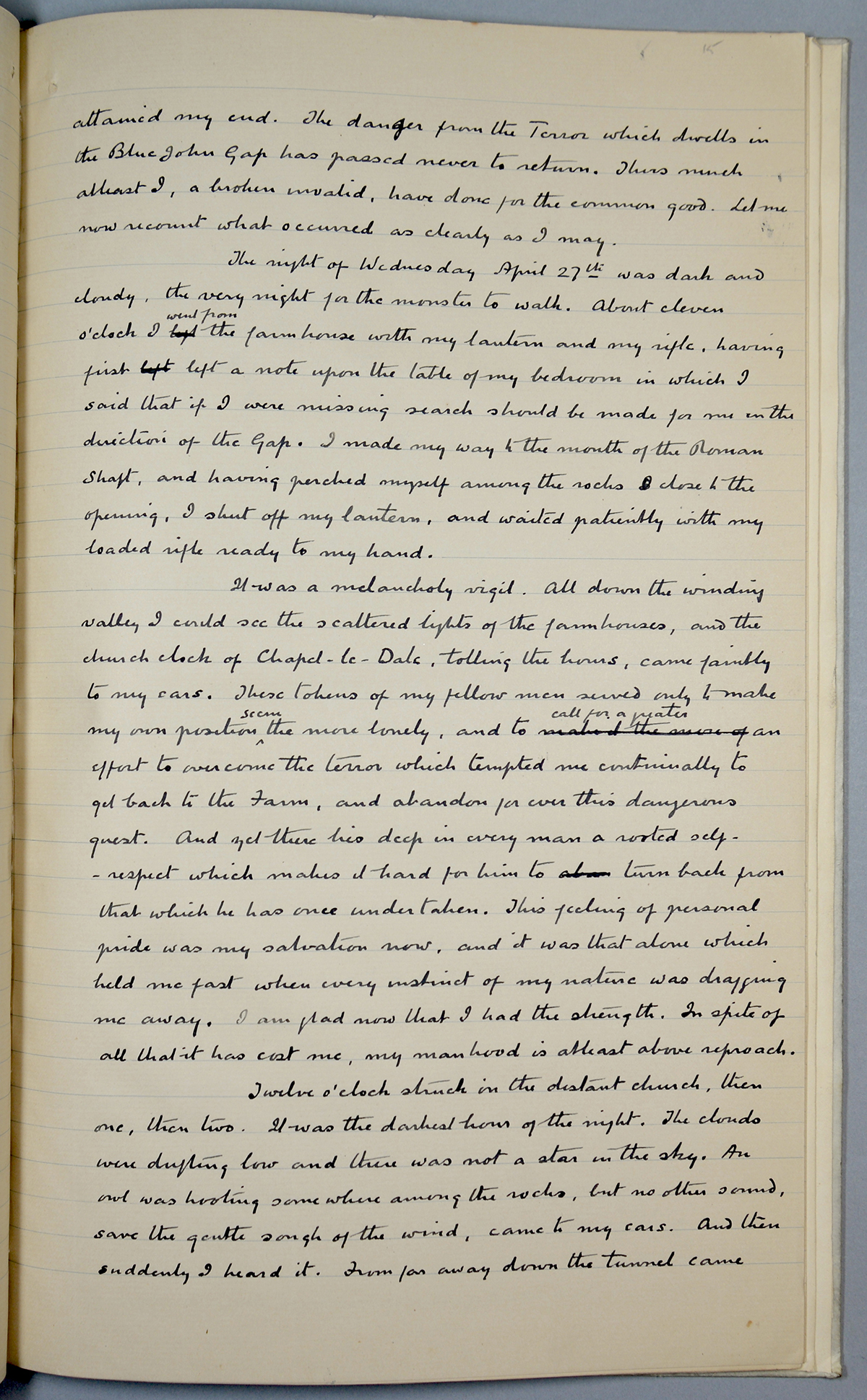
page 15 of the manuscript of The Terror of Blue John Gap

The autograph manuscript of “The Terror of Blue John Gap” reproduced above is courtesy of Dartmouth College Library, Rauner Special Collections, MS-93: Sir Arthur Conan Doyle.


Transcription

attained my end. The danger from the Terror which dwells in

the Blue John Gap has passed never to return. Thus much

at least, a broken invalid, have done for the common good. Let me

now recount what occurred as clearly as I may.

The night of Wednesday April 27th was dark and

_cloudy, the very night for the monster to walk. About eleven

o'clock I [deleted: left / inserted: went from] the farmhouse with my lantern and my rifle, having

first [deleted: left] left a note upon the table of my bedroom in which I

said that if I were missing search should be made for me in the

direction of the Gap. I made my way to the mouth of the Roman

Shaft, and having perched myself among the rocks [deleted: I] close to the

opening, I shut off my lantern, and waited patiently with my

loaded rifle ready to my hand.

It was a melancholy vigil. All down the winding

valley I could see the scattered lights of the farmhouses, and the

church clock of Chapel-le-Dale, tolling the hours, came faintly

to my ears. These tokens of my fellow men served only to make

my own position [inserted: seem] the more lonely , and to [deleted: make it the more of / inserted: call for a greater] an

effort to overcome the terror which tempted me continually to

get back to the farm, and abandon for ever this dangerous

quest. And yet there lies deep in every man a rooted self-

- respect which makes it hard for him to [deleted: aban] turn back from

that which he has once undertaken. This feeling of personal

pride was my salvation now, and it was that alone which

held me fast when every instinct of my nature was dragging

me away. I am glad now that I had the strength. In spite of

all that it has cost me, my manhood is at least above reproach.

Twelve o'clock struck in the distant church, then

one, then two. It was the darkest hour of the night. The clouds

were drifting low and there was not a star in the sky. An

owl was hooting somewhere among the rocks, but no other sound,

save the gentle sough of the wind, came to my ears. And then

suddenly I heard it. From far away down the tunnel came


The full story as it was printed in The Strand is available at
The Arthur Conan Doyle Encyclopedia.